First-time-job-seekers
Created and funded by The Hong Kong Jockey Club Charities Trust, JC PROcruit C has completed two successful phases in four years. The one-year traineeship programme developed 16 emerging job roles in the four sectors, including Creativity, Technology, Business, and Healthcare. The programme supported close to 1,000 first-time-job-seekers from sub-degree and Bachelor degree holders to embark on a professional journey in promising professions.
Are you also a recent or soon-to-be graduate navigating the transition from school to work? Whether you are exploring suitable roles, starting your job search, polishing your CV, preparing for interviews, preparing to start a new job, or even navigating challenges in a new role, this page offers career-related experiences and insights from JC PROcruit C for first-time-job-seekers:
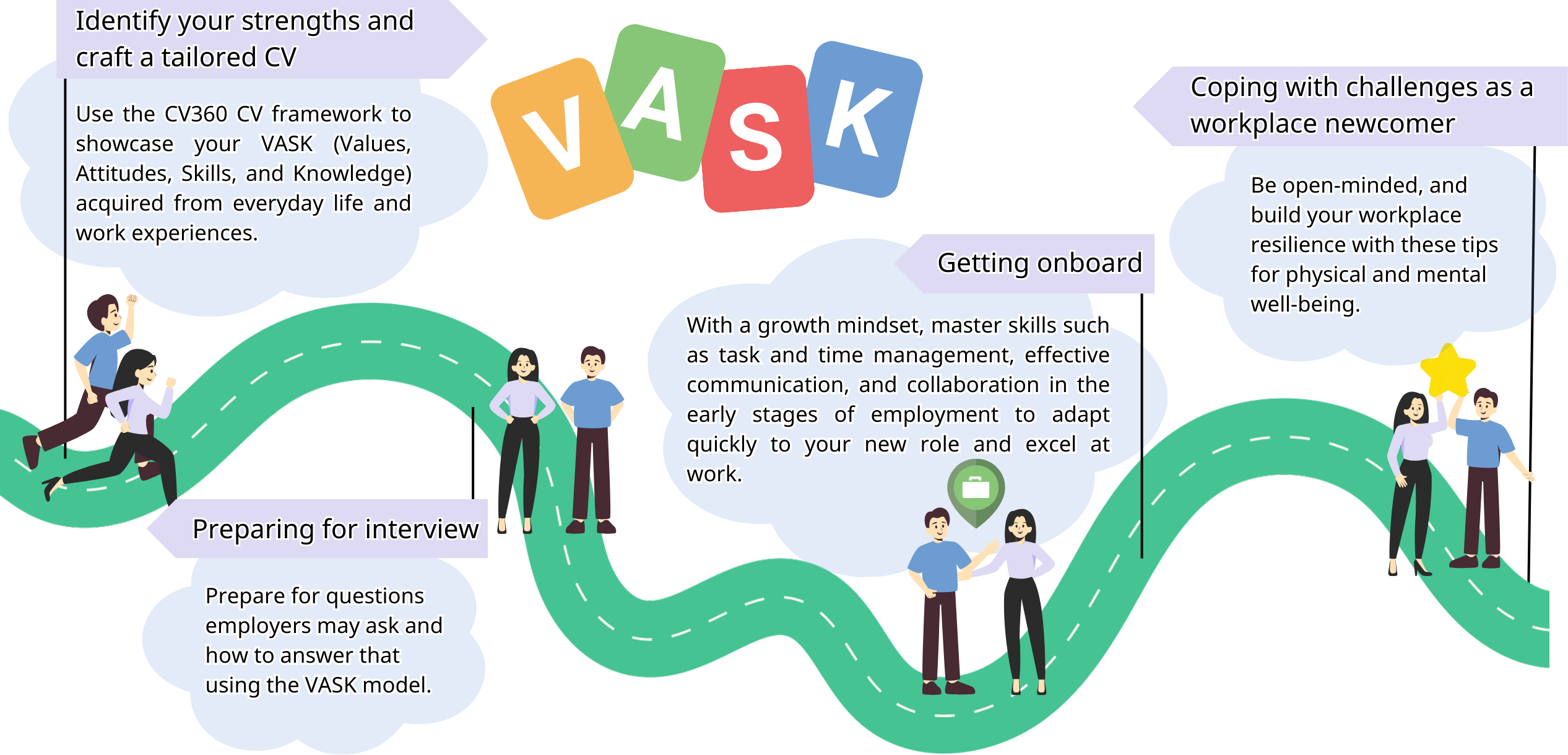
Hello! What is your biggest career challenge right now? We are here to help with advice and insights!




Showcase Your Uniqueness and Strength Through Your CV
Before writing a CV
Your CV could be presented from two perspectives: who you are and the kind of candidate the employer seeks. JC PROcruit C’s experience in successfully matching nearly 1,000 first-time-job-seekers with traineeships has shown that, in addition to educational and professional qualifications, many employers value applicants’ Values, Attitudes, Skills, and Knowledge.

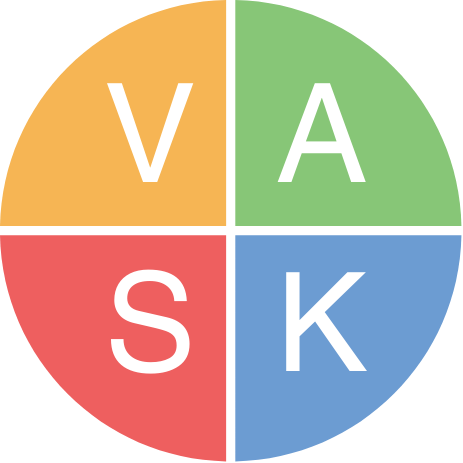
What does VASK stand for?
- One’s judgement of what is important in life.
- Values act as principles for decision making and action, and also inform attitude.
- How one views and responds to someone or something which, in turn, influences his/her thoughts and actions.
- Enable the proper management of items, data, and relationship with others.
- Experiences, know-hows, and how-tos that help individuals achieves things.
Understanding your own VASK: Guiding questions
- What do you want to know about yourself? How do you think about yourself?
- Which of your experiences were the most memorable to you? Why?
- During the experience you have just shared, what exactly made you feel most content, proud or satisfied? Why?
- During or after that experience, what did you discover about yourself? Which part did you treasure most? What kind of attitude / behaviour was reflected in this experience? Which areas / what kind of things or skills did you become knowledgeable about?
- How will you achieve your goals using the skills and talents you have developed?
Creating your CV
After identifying your qualities and strengths, consider adopting the CV360® concept for your CV. Developed based on the idea of Expanded Notion of Work (ENOW), CV360® broadens the definition of work by emphasizing the equal importance of paid and unpaid experiences. By combining this concept with the VASK model, you can showcase a more comprehensive picture of your capabilities and how they align with the applied position. This approach helps employers recognize the hidden value in your growth and experiences, such as skills and attitudes developed through community involvement or entrepreneurial endeavors.
What is CV360
Sample CV using CV360®
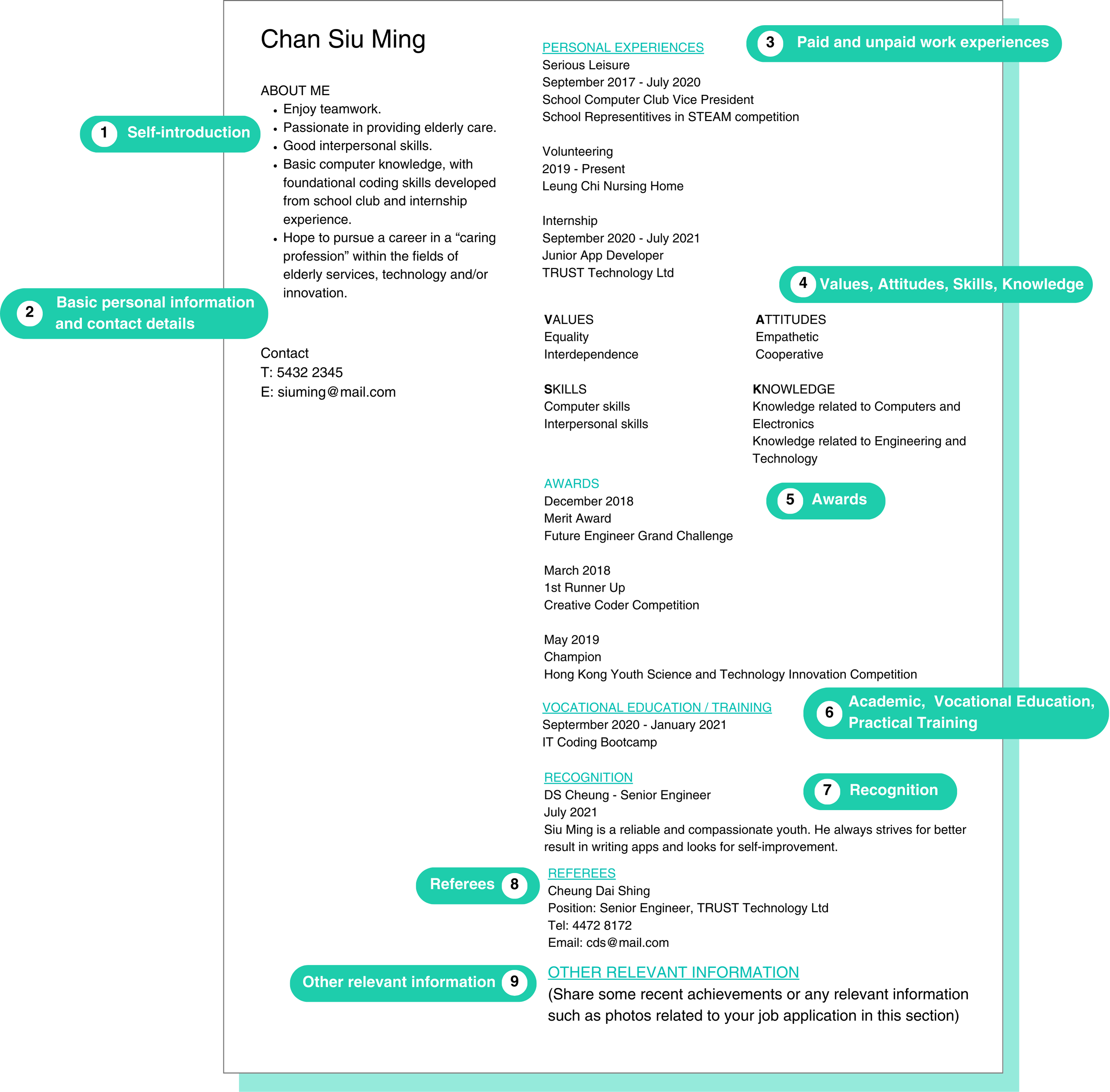
You can refer to the following pages according to your needs to learn more about how to use VASK and CV360® to identify your strengths and create your CV!

Preparing for interview
General preparation

- Review the job posting and your submitted CV again.

- Analyse the job description, company information (mission/values, key projects), and list all relevant VASK attributes. Compare them to the VASK listed in your CV.

- Based on your analysis, prepare a self-introduction in both English and Chinese.

- Consider potential interview questions about your CV, unpaid work experience, and various work scenarios, and prepare responses in advance.

- Choose appropriate attire to demonstrate your professionalism.

- Confidently showcase your personality and
capabilities during the interview.
Sample interview questions
- How would you leverage your VASK to fulfill the job requirements and benefit the company and our customers/clients/stakeholders?
- Share experiences or stories that demonstrate how your VASK aligns with the needs of our company and this position.
- How do you envision your VASK contributing to your long-term career growth?
- How can you further develop your VASK within this professional field?
- What are your short-term and long-term career aspirations?
- How do you handle unexpected situations or challenges?
Post-interview reflection
- During the interview, did you clearly communicate to the interviewer(s) why they should hire you and why you are a good fit for this position?
- Did you effectively convey your enthusiasm for the position?
- Did this interview provide you with any new insights into yourself?
- What went well during the interview, and what areas could you improve upon for next time?
Getting onboard
Congratulations on receiving your offer! You are about to embark on an exciting journey in the professional world. The followings are the themed topic provided by the programme education and training partner, HKIAS of The Chinese University of Hong Kong to the trainees through professional career coaching. With a growth mindset, master skills such as task and time management, effective communication, and collaboration in the early stages of employment to adapt quickly to your new role and excel at work.
I am getting onboard
The traineeship model of JC PROcruit C provides continuous learning opportunities and career coaching to support the school -to-work transition of first-time-job-seekers and enhance their work readiness. The trainees were also inspired by the concept “Caring Profession” at work. Over 80% of the trainees from two Phases of the programme were satisfied with the on-the-job trainings and coaching provided.
You may refer to the JC PROcruit C training and coaching structure to further enhance your skills after onboarding:
Pre-employment bootcamps
Pre-employment bootcamp arrangement:
- Workplace soft skills
- Effective communication, team collaboration to problem-solving skills
- Sector development and trends
- Foundational knowledge and skills for the respective sector
- Future career pathways within their roles
Industry-specific trainings:
- Introduction to the basic concepts and ecosystem of social innovation, culture, arts, and creativity
- Arts and creativity spaces visits
- Community observations/explorations followed by Design Thinking workshops
- Human Library sessions
- Introduction to the Kindergarten Education Curriculum Guide
- Child development and learning theories and case studies
- Impact of arts education on children’s development
- Play theory
- The role of teachers
- Activity facilitation and classroom management techniques
- Visits to early childhood education institutions and related organisations
- Common everyday tasks in early childhood education institutions
- Tech industry and its future development
- Workshops (design thinking, product design, critical thinking and problem-solving skills, digital marketing, UX/UI and web design)
- Introduction to the latest technologies (3D printing, metaverse, blockchain, cryptocurrency, data science, artificial intelligence)
- Proposal writing techniques
- Introduction to the United Nations Sustainable Development Goals
- “Caring” entrepreneurship and business models
- Case studies of successful tech startups
- Trends in people-centric tech fields
- Company visits
- CSR concepts and case studies
- ESG and UN Sustainable Development Goals and case studies
- CSR and sustainability reporting and international/local indicators
- Sustainability communication
- CSR report case studies
- Seven categories of property management
- Emerging trends in social services
- Social media copywriting and graphic and video production
- Data analysis
- Design thinking workshop
- Company visits
- Physical and mental transformations, and common illnesses of persons with disabilities and the elderly
- Service delivery skills (e.g. feeding, lifting, escorting, communication, wheelchair usage, vital sign measurement, activity design and implementation)
- Site visits to service units
- Introduction to gerontechnology
- First aid workshop
- Professional ethics and relevant regulations
- Common illnesses or mental disorders assessment and prevention
- Rehabilitation methods and tools
- Mental illness destigmatisation
- Community support resources in Hong Kong
On-the-job training
JC PROcruit C’s continuous on-the-job training allow trainees to acquire industry- and role-specific skills and knowledge. In addition to the provision of professional trainings, the programme also encourages trainees to actively participate in practical industry experience and community services.




Social Innovation Workshops
JC PROcruit C organises two social innovation workshops for trainees to learn how to apply various tools to analyse and address social needs. These workshops:
- Share success stories and experiences of an EdTech start-up, demonstrating the application of social innovation concepts and related tools in real life
- Inspire trainees to adopt a social innovation mindset to solve various social issues by sharing real cases from local communities, promoting the sustainable development of society
Regular group career coaching
By revisiting the challenges faced by trainees at work, these coaching sessions help develop their resilience and explore more solutions and collaborative strategies for these challenges. This not only helps trainees develop a diverse set of soft skills, but also builds a peer support network and deepens their understanding of VASK in career planning.
Programme Design:
Conducted in group with trainees from different industries to facilitate exchange of views. There were 6 sessions of career coaching, each around 2 hours with different themes, including:

Coping with challenges as a workplace newcomer
Hong Kong Institute of Asia-Pacific Studies of The Chinese University of Hong Kong, as an Education and Training Partner of the programme found from the surveys that the first-time-job-seekers are facing common problems and challenges as following:




So, what can you do? Apart from the five well-being tips, this 3-step emotion management approach may help you build emotional resilience:

Cultivate Emotional Awareness
Understand the facts: Many emotions and behaviors are triggered by our thoughts and interpretations of events, not the events themselves. However, emotions can influence how we perceive events. At this stage, you can observe each moment with a non-judgmental attitude. Focus on understanding the situation rather than criticising yourself or others. (Remember, changing the cause is more effective than assigning blame).
Break Free from Unhelpful Patterns
When your emotions don't align with the facts, or when acting on your emotions is ineffective, consider taking the opposite action as each emotion has an associated behavioral urge. For example, if you feel fear, your emotions may urge you to flee or avoid, but you can choose to accept and face the situation.
Build a positive cycle by increasing cognitive flexibility and developing effective coping strategies.